Cart
0
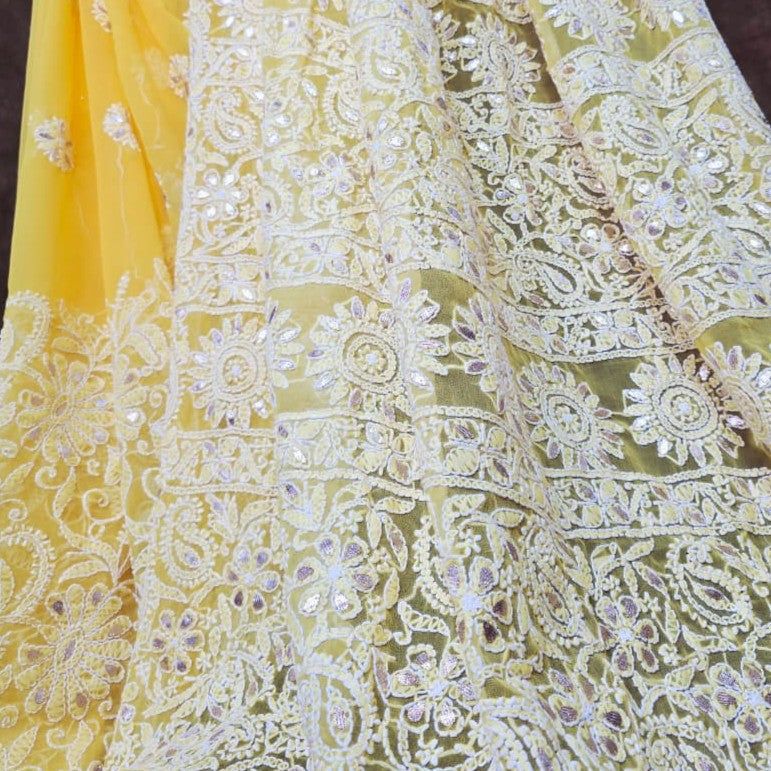
Chiffon has a peculiar way of making anything placed upon it look as though it might drift away. A fold catches the light, a border changes position with the body, and the fabric seems to register movement before the eye has quite followed it.
Then there is the needlework.
Set against such a light ground, embroidery acquires a different presence. It does not sit on the saree like an applied ornament. It appears to inhabit the fabric, sometimes catching light, sometimes disappearing into it, becoming legible only when the wearer moves. The contradiction is part of the fascination: a material associated with fluidity carrying marks produced through patience and concentration. This is one reason a handcrafted chiffon chikankari saree deserves to be considered on rather different terms from a garment chosen simply for its appearance. Its interest lies in the conversation between what the fabric wants to do and what the hand has asked it to hold.
The fabric moves. The needlework stays.
Chiffon is rarely visually static. It gathers, releases, floats away from the body and returns to it. A saree in chiffon can change considerably between being laid flat and being worn. What looked like a particular arrangement of embroidery on a table becomes something more dispersed once the fabric is pleated, wrapped and allowed to fall. Handwork responds to this behaviour in ways that can be surprisingly subtle.
A motif may seem quiet when viewed up close, then become a fleeting pattern as the saree moves. Areas of embroidery can interrupt the transparency of the ground without making the garment visually dense. A border can establish a line while the rest of the fabric remains in motion. That interaction matters. The embroidery is not merely decoration placed upon chiffon; it alters how the eye reads the fabric as it moves. A heavily embellished saree often announces its surface immediately. Chikankari can ask for a second look. The reward is less about visual volume than about changing perception: what appears delicate from a distance can reveal considerable handwork when seen nearby, while the overall garment retains its lightness. The result is a form of ornament that does not have to compete with the person wearing it.
Imperfection is part of the evidence
Machine production is exceptionally good at consistency. The same motif can be repeated with astonishing precision, and in many garments that regularity is precisely the point. Hand embroidery introduces another possibility. Two motifs may not be absolutely identical. A line may carry a minute variation in tension. A repeated element may reveal the person who worked it rather than the logic of a programmed sequence. Such differences are easy to describe as flaws if clothing is judged solely by industrial standards. But that interpretation misses something important: variation can be evidence.
It tells you that the surface was made through a sequence of human decisions rather than reproduced solely for uniformity. The distinction is one of degree and character. A thoughtfully made piece can retain small signs of the hand without losing coherence. For the wearer, those signs create a curious sense of proximity. The garment does not look as though it emerged untouched from a system designed to eliminate individual trace. Somewhere within its surface is evidence that another person spent time making one section, then another, then another.
That knowledge changes the object.
Chikankari works quietly
There is a particular restraint to chikankari when it is allowed room to breathe. It's visual language does not depend entirely on sparkle, density or dramatic contrast. On chiffon, this restraint becomes even more apparent. This is where a handcrafted saree can feel more considered than a garment covered from edge to edge. The eye is given pauses. A small embroidered passage can become more noticeable precisely because it is surrounded by unworked fabric. A motif does not have to occupy every available inch to establish a rhythm. The spaces between marks become part of the design.
There is something increasingly compelling about this kind of restraint. In an age of garments engineered to photograph instantly and communicate their value at a glance, subtle workmanship asks for a slower form of looking. It is clothing that rewards proximity. You notice the embroidery when you are close enough to someone to see it properly. You notice how the pattern shifts across a pleat. You notice a small variation that a photograph would flatten.
The surface changes when it meets the body
A saree cannot be understood completely while it is hanging on a rack. Its real design emerges through movement. Pleats create repeated layers. The pallu opens and closes as the wearer walks. The fabric catches air. Sections overlap, making some embroidered areas more opaque and others almost disappear. Chiffon is particularly responsive to these changes because its visual character is so dependent on fall and light.
Handwork gives that movement punctuation. An embroidered section may appear more pronounced where the fabric gathers. Elsewhere, the same work can soften into the ground. Under one kind of light it reads clearly; under another, the surface becomes quieter. This makes the saree unusually dependent on the wearer. The garment does not deliver one fixed image. It produces a sequence of images as the body moves through space. That is a very different proposition from buying a garment primarily for its photograph. It also explains why understated embroidery can have such staying power. A densely decorated surface can give you its entire visual argument immediately. A lighter handworked surface continues to reveal itself through wearing. The saree becomes something you experience rather than simply display.
There is a difference between wearing decoration and wearing workmanship
The distinction may sound slight, but it changes the emotional character of a garment. Decoration is concerned principally with what is added to a surface. Workmanship makes you conscious of how that surface came to be. A handcrafted chiffon chikankari saree belongs to the second category. Its value is not exhausted by the visible motif. Part of what you are purchasing is the accumulated time embedded in that motif—the repeated physical act of making marks by hand, and the concentration that process requires.
In fact, the more useful way to think about it may be almost impersonal. A certain amount of time has passed between an unworked piece of fabric and the finished garment. The saree carries the consequence of that time. This is one reason a handworked piece can feel intimate even when its design is restrained. The intimacy does not come from being ornate. It comes from knowing that the surface could not have appeared instantaneously. There is a human interval inside the object. For a discerning wardrobe, that distinction can be more meaningful than another layer of embellishment.
The price of slowness is not merely financial
A handcrafted saree may cost more. It may take longer to produce. It may require more considerate handling than a garment selected for convenience. Those are real considerations, not inconveniences that need to be disguised. Handwork can involve variation. Chiffon can demand care. A saree made with patience is not necessarily the piece one reaches for when every decision needs to be frictionless. But these characteristics can also explain why the garment remains interesting.
A machine-produced version can reproduce the appearance of handwork convincingly enough for many settings. If the only criterion is visual similarity, the distinction may not justify the additional cost for every buyer. The case for the handcrafted piece begins elsewhere. It is the case for process. For someone who values the feel of a material that has not been standardised into complete sameness, the extra care becomes part of ownership rather than a burden attached to it. The slower production period can make the eventual garment feel less interchangeable. The possibility of small variations means that choosing one is not quite the same as selecting a copy from an endless row. This is not an argument that handmade automatically outranks machine-made. It is an argument that they offer different relationships with clothing. One privileges repeatability. The other permits traces of the making to remain visible.
A saree with a longer life in the wardrobe
The most interesting question is perhaps not where a handcrafted chiffon chikankari saree can be worn. It is what kind of place it can occupy. A garment purchased solely for a particular event is often trapped by its own premise. Its memory becomes attached to one date, one set of photographs, one version of the wearer. A restrained handworked saree has another possibility. Because its visual language does not depend entirely on spectacle, it can move between different parts of a wardrobe without feeling as though it has been reduced to an “occasion outfit.”
Its character can come forward or recede according to how it is worn.
Change the blouse, jewellery, styling or manner of draping, and the embroidery can read differently without losing its identity. The saree remains recognisable while the context around it changes.That is a valuable quality in clothing: not endless versatility for its own sake, but enough composure to acquire new associations. The first wearing may belong to an event. The second may belong to an evening when dressing well simply feels appropriate. Eventually, the garment can become associated with neither occasion nor season, but with the person who keeps returning to it. That is when a purchase becomes part of a wardrobe rather than an acquisition waiting for its assigned date.
What remains after the novelty disappears
The strongest reason to buy a handcrafted chiffon chikankari saree may be the least obvious one. It has the potential to become more interesting to its owner over time. Not necessarily because it becomes more valuable in a financial sense, and certainly not because age magically improves every garment. Rather, repeated wearing changes the meaning of clothing. We begin to remember how a particular fabric moves, where its pleats fall, which light reveals its embroidery most clearly.
The saree develops a history through use. Handwork gives that history somewhere to attach itself. The small irregularities, the restrained pattern, the way embroidery interrupts the transparency of chiffon—these details become recognisable as belonging to that particular saree. Eventually, one stops seeing merely “chikankari on chiffon.”
One sees that saree. This may be one of the quieter shifts taking place in discerning fashion: a movement away from judging luxury solely through rarity, price or visible ornament, and toward asking harder questions about provenance, process, tactility and authorship. The most persuasive luxury is not always the one that can be identified from across a room. Sometimes it is the one that rewards being near it.
A handcrafted chiffon chikankari saree belongs to that category. Its lightness makes the labour beneath its surface more intriguing, not less. Its restraint gives the workmanship room to register. Its movement prevents the embroidery from becoming a static pattern. And its small departures from perfect repetition can remind the wearer that clothing need not be anonymous to be refined. There is, finally, a particular pleasure in wearing something whose appearance is inseparable from the fact that someone spent time making it. The hand does not merely leave a mark on the cloth. It leaves the garment with a history of making—and that is what the wearer carries forward.